 I mean it. There are lots of Twitter accounts presenting some interesting, and clearly AI manipulated, photos and movies. These same accounts are presenting these photos and movies as “evidence” of various conspiracy theories.
There’s one video that “shows” someone cutting what appears to be stone and claiming that the mineral band being cut is fossilized blood of a giant. Thereby proving that giants, (Godzilla sized), existed in the past. I lost interest after that it was a lot of blah, blah, blah, from a monotone computer generated voice.
The shape of the material in the video appeared to be more treelike, the saw being used was similar in appearance to a saw I’ve seen used in logging operations to cut logs to a uniform size prior to loading them onto a transport truck. The saw moved far too fast to be cutting stone.
There’s another montage of “Ancient” sites that looks like really old black & white photos. The video provocatively claims that governments around the world are hiding “The Truth” from us all. Some of the photos are of buildings or sites that I have seen before with clever additions that look like variations of the “Stargate”, from the movie of the same name. This montage of still photos interestingly has film artifacts, (dust, debris, voids in the emulsion, etc.) Why would a new video montage of “Old” still black & white photos have film artifacts throughout it? Why would the video be jumpy as though it was taken in motion when the subject is a still photo? Why do so many of these photos look as though the scale of the objects shown has been manipulated to make the object appear larger than the “Humans” in frame?
Don’t get me wrong, the image manipulation is very cleaver and quite good. With time, I believe that I have the tools on this computer to learn to manipulate images in a similar fashion. The AI can simply do that kind of manipulation faster and easier.
Therein lies the danger.
There are a lot of people whose grip on reality is tenuous enough without having their reality disrupted by images that must be looked at critically to determine if they’re real or not.
There are tons of people who look at the incoming flood of data from sites like, TikTok, Twitter, Instagram, Facebook, and whatever other social media, as the absolute truth.
These videos are all come ons, they’re supposed to get the gullible to go to a web site to “donate” so the purveyors of these “Hidden Truths” can continue their good work uncovering what’s been hidden from the world. With Twitter and Instagram subscription models they’re even able to make money just from folks interacting with their wacky videos.
Don’t get me wrong, I’m from the P.T. Barnum school of capitalism. I simply wish I’d thought of it first.
I also want to believe that there are aliens, or unexplained things beyond the mundane scratching and scurrying of the insane apes on this planet.
 That’s what these videos and sites capitalize on…
The human need to believe that there is something bigger, better, and more majestic than ourselves.
Religions around the world are based on this need. The Catholic Church in particular has been quite good at monetizing the human need to believe, especially if the rumors about the wealth contained in Vatican City are true.
There have also been a number of “Free Energy” videos recently. These are laughable until you look at the account’s follower numbers. Then you think, “How are that many people, this dumb?” Entropy always wins.
These videos typically show what is clearly the armature from a DC motor. Probably taken from a toy. The windings look like they’ve been done by machine. Anyway the video is often a bit jiggly, (why are a lot of these videos are jiggly? To add / imply excitement at “discovery”?) , but shows the armature mounted such that it can spin freely. There are two wires trailing out of frame, the ends of the wires that are visible, are laid against the contacts of the armature. An LED or LED strip sitting next to the armature, is presumably connected directly.
The scam is that you see two human hands bringing curved magnets (probably from the original casing of the motor) near the armature, and it miraculously begins spinning. But the second miracle is that the LED lights up. Ohhhh Ahhhhh. It’s magic!
No it’s a DC motor. The LED is either being powered by another power source or is in series with whatever is providing power to the armature itself. The coils on the armature create a magnetic field when current is applied. This field is attracted to the fixed magnets the human is holding, causing rotation of the armature. The spacing of the contact pads on the armature causes the coils to be energized and de energized as the armature rotates. So what you have is temporary electromagnetic fields sequentially being attracted to the fixed magnets being held nearby.
This is not magic. It’s not free energy. It’s science. Worse, it’s simple well known science.
The account directs you to a ‘free energy” site where you can subscribe, or buy “Plans” for your own free energy generator to experiment with.
Maybe I’m the odd ball. But I was doing shit like this in my bedroom, in a flyover redneck state, at around the time of the Cuban Missile crisis. (Okay perhaps a little later than the actual crisis.) The point is, when my toys broke, I took them apart to see if I could fix them, or to figure out how they worked. I was learning by doing.
Later in school, I was fortunate enough to attend schools with robust science curriculums and since those schools didn’t look or act like prisons, we could bring things from home to augment science classes.
Apparently these days the basics of science are not being taught in school. Which leads to at least one, maybe several generations of gullible rubes, ripe for the P.T. Barnum treatment.
Two of my favorite Barnum quotes are:
“Many people are gullible, and we can expect this to continue.” – P. T. Barnum
“There is a fool born every minute” – P. T. Barnum
The common thread is that there are people making money from other stupid people. That has been true for as long as there’ve been people and money.
 My concern is that people are geared to believe what they see.
Videos have become so easy to make, Generative AI has become commonplace and easy to use. When you factor these things together you’re begging for a new techno dark ages.
All the knowledge of humanity will be available on the internet instantly.
But it’s mixed in with absolute garbage. And a lot of people don’t have the reasoning capacity or facts to separate the truth from the fiction or even to resolve conflicting information using simple logic.
I seriously wonder if, no, when the powers that be unleash disease X as the WEF and WHO dubbed the next pandemic, how gullible people might be.
I could see a scenario like this, on so called “Truth” websites generated by AI using compelling images and fear.
[WARNING! DO NOT DO THIS! THE SCENARIO BELOW IS FOR ILLUSTRATIVE PURPOSES ONLY]
A Montage of ambulances and fires in a generic city. Headline in the montage, “Disease X Ravages Country, Film at 11:00″
Then images of sick people on ventilators, skin and bones images from the AIDS crisis being portrayed as happening now, Headline “They’re hiding the truth, they want you to die. We have the cure. Discovered by German scientists in World War I and used to cure diseases running rampant among soldiers in the trenches, this cure can save your family.”
A web address pops up on the video. “With just two chemicals likely already in your house you can protect your family and be safe.”
The web site asks for a one time payment of $29.95 for instructions on how to be safe.
The “Cure” is this. Duct Tape your doors and windows shut. Put on a surgical mask to protect yourself during the “Home Sterilization process”. Then mix Bleach and Ammonia in every sink and toilet in your house.
The instructions inform you that any discomfort you feel is the invisible mist seeking out and killing Disease X, if you feel discomfort, it means you’re infected and purchased the cure to the disease just in time. Good Job! That $29.95 is money well spent, you’ve saved your family.
A person from my generation wouldn’t do this. Even if we don’t remember why we were taught not to do this. I was taught this as part of a science class in elementary school. I vaguely recall perhaps some flammability? I’m not even sure what the gas produced is. I want to say Hydrogen Chloride but it’s been too long… I don’t remember clearly. I only remember that the combination produces a poisonous gas. Which in an enclosed space is deadly.
I remember science classes being fun because where practical, the principals were demonstrated. There was always a lit bunsen burner in my classes.
These days, with the generations after mine, I don’t honestly know if they’d have the safety protocols in their heads to say, “Uh Nope! That’s a really bad idea.”.
If a convincing AI video said it was safe and effective, or worse if the generative AI used a trusted human face and voice to provide instructions, then people without grounding in basic science, who are fearful and gullible, could be convinced to do something really dangerous.
The scenario above hits on three points in human decision making.
Fear, desire to believe (hope), and payment (if I purchased it, it must have value.) There’s an optional fourth point. Mistrust.
People are far more likely to believe that the government, the elites, or the powers that be, are either withholding information OR that everything said by this group is 100% factual. We saw this in COVID. There were two very clear camps and questioning the dogma of one of those camps was heresy of the highest order.
For god sake, there are still loads of people in Seattle and Portland running around wearing masks.
That’s the power of belief.
I think generative AI is really dangerous because of all of the above. Plus this one more thing. Humans seem to need to believe that computers are infallible oracles of truth.
That need to believe our creations are superior to the minds that created them, can so easily be manipulated it terrifies me.
AI has the potential to help, in so many ways. The trouble is, in the wrong hands AI can cause great harm and I think even destroy what we know.
Like all tools AI is neither good or bad. That is up to the user of the tool. History however, suggests that AI, particularly generative AI will be used for harm.
If you thought random wikipedia edits were annoying, you haven’t seen anything yet.

 Some of you may be aware that Apple has, over the past few iterations of their IOS, iPadOS, and Mac OS, been adding more active predictive text input.
 The example above is a fairly common mistake that the internal dictionaries should easily recognize and correct in English. (I recognize that there are other languages in these operating systems and those languages have different rules.)
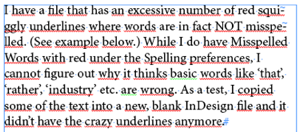 ord not only couldn’t comprehend what I’d done, Word couldn’t present me with any alternative spelling at all.
 My current MacBook Pro is about a year old. I find that shocking because usually by the time a machine reaches a year old, there are little things that tell its age. I’m not talking about scratches or stuff like that.
 Okay, at least this time Edison was not only clear about the time and date they’d be doing work.
 I think Arthur C Clarke wrote a short story about a smart house that I also read as a teen. I seem to recall it was called The Veldt I don’t know if that is correct, but the gist of the story has stuck with me for decades. Essentially it’s an anti-war piece. However, a smart house is the only character in the story. The anti war sentiment is a sting revealed in the tail of the story.
 I was off Twitter for a number of years.
 All of which makes it very easy to lose hours.
  With social media and the internet there’s an immediacy that circumvents needing clever writers or less obvious spin. It’s all about the clicks an article receives. That causes a feedback loop.
 At this point, the only human interaction is the end consumer of the media. The consumer of the media may crosscheck their views with those of their followers, who may or may not be real people. What they’ll find is consistency and that further cements their beliefs that their view is correct.
 Lastly was the humor. The Bot had zero concept about visually humorous things. Slapstick comedy, pratfalls, The Keystone Cops, The Three Stooges, The Little Rascals, Laurel & Hardy, Charlie Chaplin, & Looney Tunes, all of these things made no sense to the Bot.
 Once I’d concluded that I was having a conversation with a Bot. I told it, “You’ve failed the Turing Test.”
  My Daisy program would be designed to hunt down and dismantle AI Bots in social media. My only concern about it is that by the time I’ve written the program, dismantling AI Bots will be considered “Murder”